


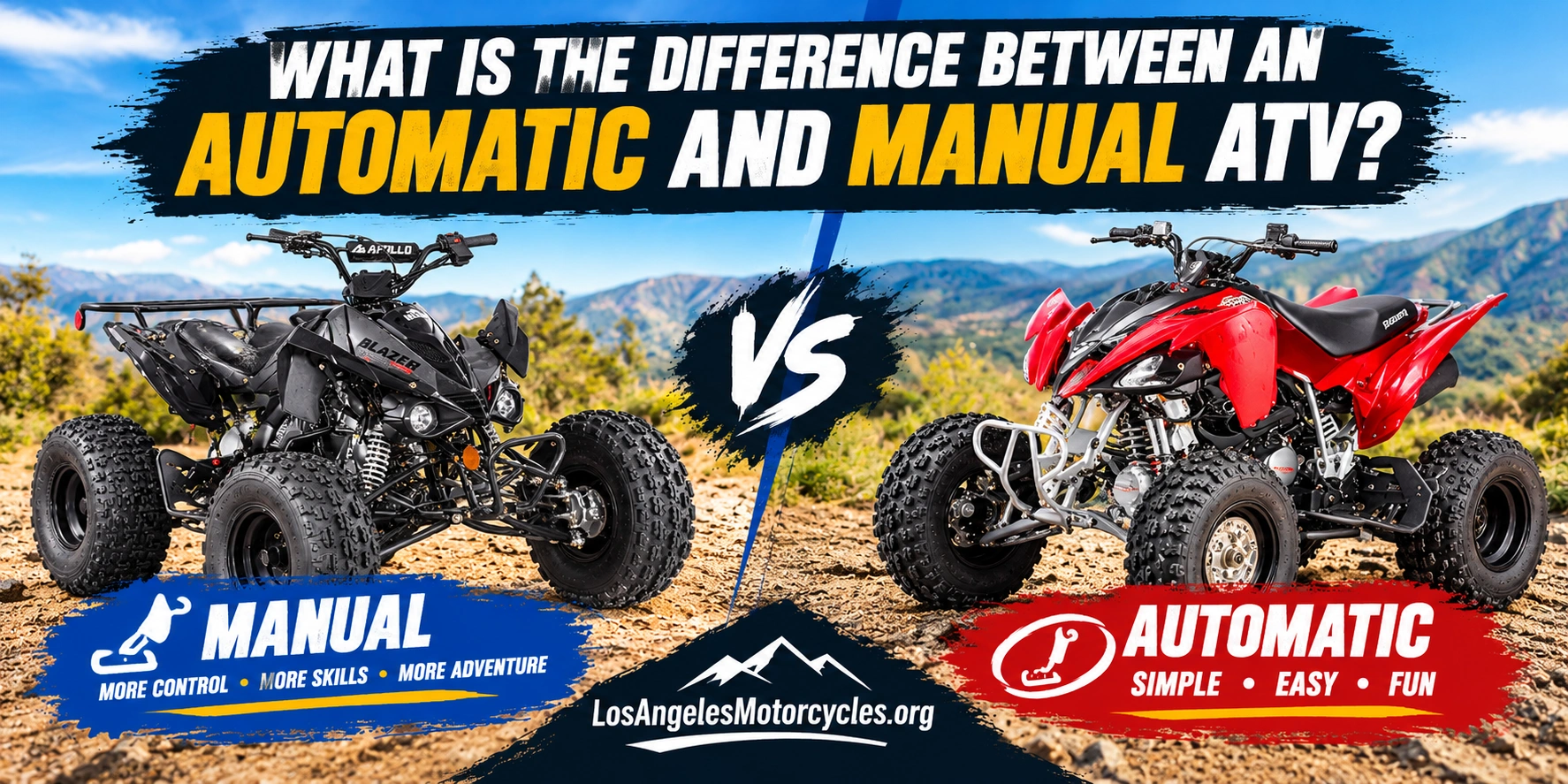
An automatic ATV has no clutch and no manual gear shifter — the transmission shifts automatically, and the rider only controls the throttle and brakes. A manual ATV has a hand clutch and a foot shifter, requiring the rider to manage gear changes manually. A semi-automatic ATV is a middle ground — foot shifter without a hand clutch. For most first-time riders, an automatic is the right starting point. FE Motorsports at 2916 S Santa Fe Ave, Los Angeles carries automatic, semi-automatic, and manual ATVs in stock.
Automatic ATV — How It Works
On a fully automatic ATV, the transmission handles gear selection without any input from the rider. The rider opens the throttle to accelerate and squeezes the brake to stop. There is no clutch lever on the handlebar and no foot shifter. The bike moves when you apply throttle and stops when you apply brake.
This is the simplest possible operating experience for a new rider. The learning curve is entirely about throttle control, braking technique, and terrain reading — not mechanical operation. Speed governors and remote kill switches are standard on youth automatic ATVs, giving parents control over maximum speed and an emergency stop from a distance.
Examples at FE Motorsports: Vitacci Hawk 110cc (fully automatic, youth), Apollo Blazer 9 125cc (available in automatic).
Semi-Automatic ATV — How It Works
A semi-automatic ATV adds a foot shifter to the automatic setup but removes the hand clutch. The rider shifts gears with their left foot — typically upshifting by pressing down and downshifting by lifting — but does not need to engage a hand clutch to make the shift. The transmission handles the clutch engagement automatically.
This is the natural mechanical step up from fully automatic. The rider learns gear selection and shift timing without the added complexity of clutch management. It’s the intermediate step between fully automatic and full manual.
Examples at FE Motorsports: Apollo Blazer 9 125cc (semi-auto option), Vitacci Jet 9 125cc.
Manual ATV — How It Works
A full manual ATV has both a hand clutch and a foot shifter. The rider must disengage the clutch before shifting gears and re-engage it smoothly after the shift — the same process as a manual car or motorcycle. This requires the most mechanical skill but gives the rider the most precise control over power delivery.
Manual ATVs are appropriate for experienced riders who have developed foundational skills on automatic or semi-automatic platforms. Adult ATVs like the Apollo Commander 200 and Apollo Pentora 200 EFI at FE Motorsports are in the manual category.
Which Should You Choose?
For a first-time rider with no prior experience on motorized vehicles: fully automatic. The learning curve is entirely about riding, not mechanical operation. Start here regardless of the rider’s enthusiasm level — foundational skills transfer to manual platforms later.
For a rider with experience on a fully automatic platform who is ready for the next step: semi-automatic. Introduces gear shifting without the clutch complexity.
For an experienced rider who wants full mechanical control: manual. Adult-sized ATVs with manual transmissions handle experienced riders on demanding terrain.
For more on choosing the right platform, see What Is the Difference Between a 110cc and 125cc ATV for Kids? and Youth Dirt Bikes in Los Angeles — What Parents Need to Know.
FE Motorsports at 2916 S Santa Fe Ave, Los Angeles — automatic, semi-automatic, and manual ATVs in stock, fully assembled, CARB approved. Open 7 days a week. Call (323) 588-6634.
Leave a Reply