California is the only state in the United States where lane splitting is explicitly legal. For riders in Los Angeles — one of the most congested cities in the country — that single fact changes the entire commuting equation. This guide covers what lane splitting actually is, what the law says, how LA riders use it in practice, and what to know before you do it for the first time.
If you’re considering a motorcycle or scooter for your Los Angeles commute, FE Motorsports at 2916 S Santa Fe Ave carries a full lineup of street-legal bikes and scooters — open 7 days a week.
What Is Lane Splitting?
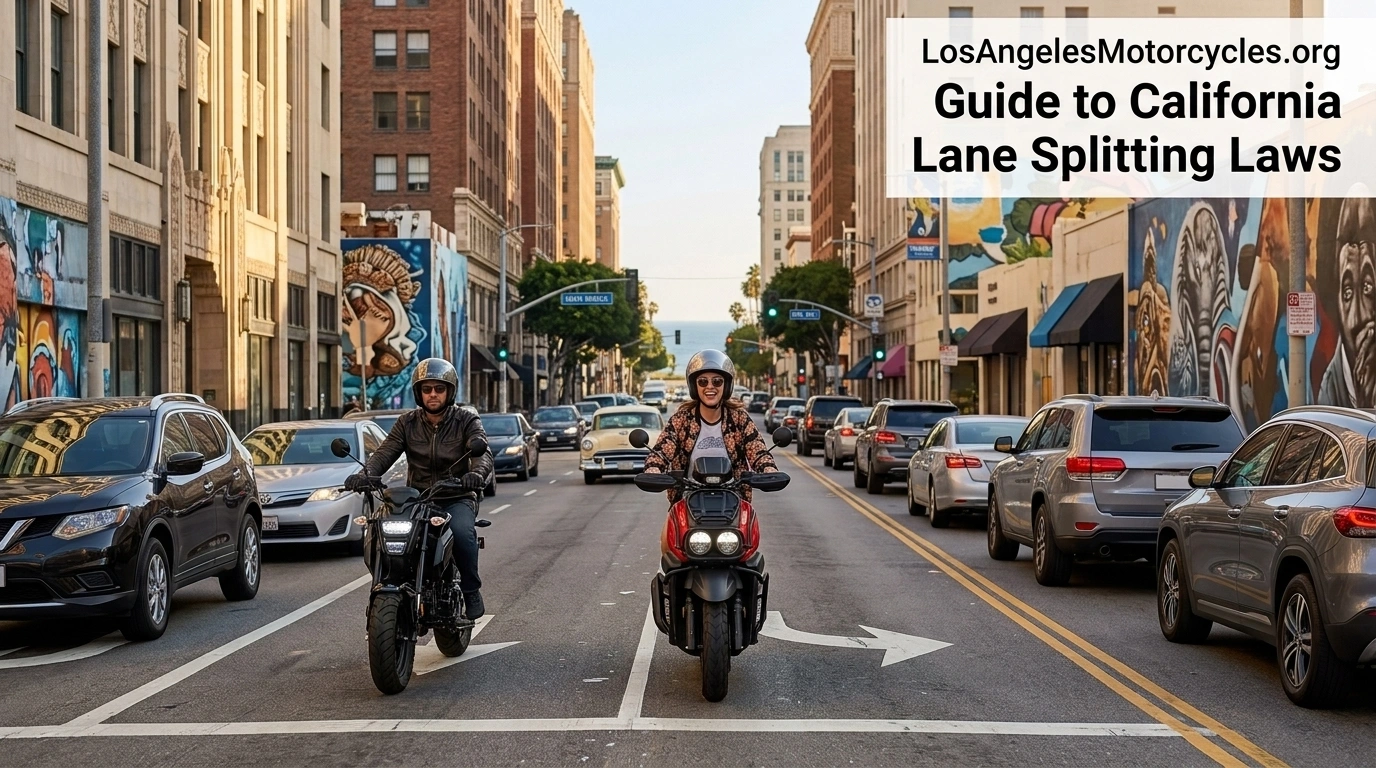
Lane splitting is the practice of riding a motorcycle or scooter between lanes of slow-moving or stopped traffic. In a typical scenario: traffic on the 10 or the 405 is backed up, cars are stopped or moving at 5–10 MPH, and a motorcycle rider moves forward between the lanes rather than sitting in the queue.
California officially recognized lane splitting as legal in 2016 when Governor Brown signed AB 51, making it the first state in the US to explicitly legalize the practice. The California Highway Patrol subsequently issued guidelines for safe lane splitting — those guidelines are not law, but they represent the standard of behavior CHP considers reasonable.
What Does the Law Actually Say?
California Vehicle Code Section 21658.1 defines lane splitting as “driving a motorcycle… between rows of stopped or moving vehicles in the same lane.” It authorizes the California Highway Patrol to develop educational guidelines.
What the law does not do is set a specific speed limit for lane splitting. The CHP guidelines — which again are not law — historically suggested keeping speed differential under 10 MPH and not splitting above 30 MPH, but those specific numbers were removed from the official guidelines. The legal standard is that lane splitting must be done in a manner that is safe and prudent given the conditions.
In practice: splitting at 15 MPH through stopped traffic on surface streets is almost universally considered reasonable. Splitting at 70 MPH between cars moving at 65 MPH is reckless and will result in a citation for unsafe lane change or reckless driving even though lane splitting itself is legal.
Lane Filtering vs. Lane Splitting
Two terms that come up in California:
Lane splitting: moving between lanes of moving or slow-moving traffic at speed — the traditional definition.
Lane filtering: moving between stopped vehicles at very low speed, typically at a red light or in completely stopped traffic.
California’s 2016 law covers both under the same section. Both are legal. The distinction matters mostly in conversation — riders sometimes use “filtering” specifically for the red-light scenario and “splitting” for moving traffic.
How LA Riders Actually Use It
Los Angeles traffic creates specific lane splitting patterns that experienced riders develop over time:
The freeway crawl. On the 10, the 405, the 110, the 101 — when traffic drops below 30 MPH, experienced riders move to the gap between the #1 lane (far left) and the #2 lane, or between the #2 and #3 lanes. The far left gap is the most common because it has the most consistent width and the fewest merging cars. Speed differential of 10–15 MPH over traffic is the comfortable range for most experienced splitters.
Surface street filtering. At red lights on surface streets — Venice Blvd, Pico, Washington, Olympic — riders filter to the front of the queue between stopped cars. This is the lowest-risk form of lane splitting: both the cars and the motorcycle are stopped or moving at walking speed. Move to the front, position ahead of the first car, wait for green.
The canyon approach. Riders heading to Mulholland, Malibu, or the Angeles Crest often use lane splitting to clear the city traffic before reaching the open canyon roads. The first 20 minutes of a canyon run from most LA neighborhoods involves stop-and-go surface streets — splitting clears that section cleanly.
Commuter use. Riders who use a motorcycle or scooter to commute in Los Angeles use lane splitting as a primary tool for predictable commute times. A 25-minute commute that would take 45 minutes in a car in traffic takes 25 minutes by motorcycle with lane splitting. That consistency is one of the most practical arguments for two wheels in LA.
The Right Way to Do It — Practical Guidelines
For riders new to lane splitting in Los Angeles:
Start slow and conservative. Your first lane splitting experiences should be at very low speeds — filtering at red lights on quiet streets before attempting freeway splits. Get comfortable with the proximity to cars before adding speed to the equation.
Watch the mirrors. Cars about to change lanes telegraph the move through their mirrors before the wheels move. If you see a driver checking their mirror repeatedly while you’re approaching, slow down or hold back.
Watch for doors on surface streets. On city streets with parking lanes, drivers opening doors into the lane is a hazard. Splitting between moving traffic and a parking lane requires more caution than freeway splitting.
The 10 MPH differential rule is practical even if it’s not law. Keeping your speed within 10–15 MPH of surrounding traffic gives you and the cars around you enough time to react. The accidents happen when the differential is too high.
Avoid splitting near on-ramps and exits. Cars entering or exiting the freeway are focused on their merge, not on a motorcycle in the lane gap. The transition zones around on-ramps are where most lane-splitting incidents happen.
Make yourself visible. High-visibility gear, headlight always on, position in the lane gap where you can be seen in mirrors. The more visible you are, the more time drivers have to see you before making a lane change.
Never split next to trucks or buses. Large vehicles have significant blind spots and cannot react quickly to a motorcycle in the lane gap. When a truck or bus is in the adjacent lane, drop back and wait for clear space before splitting past.
What Kind of Bike Is Best for Lane Splitting in LA?
Narrower and lighter is better for lane splitting. The practical ranking for LA conditions:
50cc and 125cc scooters and motorcycles. The narrowest, lightest, most maneuverable option. The Boom Evolution 50cc, Boom Vader 125cc, and similar compact platforms are genuinely easier to lane split on than larger bikes — narrower footprint, lower speed requirements, immediate throttle response.
Standard and naked motorcycles. Medium-width bikes without fairings or panniers. The Boom BD250-5 and similar platforms fit this category — manageable width, good visibility.
Sport bikes with fairings. Wider than naked bikes but still manageable. The fairing adds width that matters in tight lane gaps.
Adventure bikes, cruisers with wide bars or saddlebags. The most challenging to split with due to width. Doable on wide freeway gaps but requires more caution on surface streets.
For riders whose primary use case is LA commuting with lane splitting, a compact scooter or small motorcycle from FE Motorsports at 2916 S Santa Fe Ave is the practical answer — assembled, street legal, and sized correctly for the way riders actually use Los Angeles streets.
The Safety Reality
Lane splitting is statistically safer for motorcyclists than sitting in traffic. A 2015 UC Berkeley study conducted for the California Office of Traffic Safety found that lane-splitting motorcyclists were significantly less likely to be rear-ended than non-splitting riders. Being rear-ended while stopped in traffic is one of the most dangerous scenarios for a motorcycle rider — lane splitting removes that exposure.
The risks lane splitting introduces are the door-opening risk on city streets and the mirror-clip risk when a car changes lanes without seeing the motorcycle. Both are manageable with speed control, positioning, and situational awareness.
The riders who have problems with lane splitting are almost always going too fast for conditions. The practice itself, done conservatively, is a net safety improvement for the commuter rider in Los Angeles traffic.
The Bottom Line
Lane splitting is one of the genuine advantages of riding a motorcycle or scooter in Los Angeles. In a city where car commute times are unpredictable and parking is expensive, a street-legal motorcycle that can split traffic turns a 45-minute commute into a consistent 20 minutes and eliminates most parking friction entirely.
California made the right call legalizing it. LA riders who haven’t tried it — or who are considering a bike specifically for commuting — should understand that lane splitting is not a reckless practice when done correctly. It’s a legal, practical tool that experienced riders use every day in this city.
For street-legal motorcycles and scooters sized for LA commuting, FE Motorsports at 2916 S Santa Fe Ave, Los Angeles is open 7 days a week. Call (323) 588-6634.
For more on commuting by scooter in Los Angeles, see our guide to Chinese Powersports in Los Angeles. For the Boom Vader specifically — the most popular compact motorcycle in the LA mini moto scene — see the Boom Vader 125cc Complete Los Angeles Owner’s Guide.
Leave a Reply